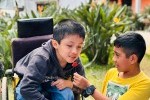
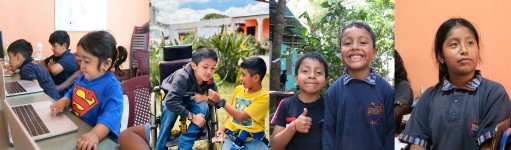
Vida Guatemala awards scholarships to children and young people from disadvantaged backgrounds, giving them access to state-recognised education. A quarter of the pupils have a disability. Additional to the official curriculum, the school offers practical subjects useful for everyday life. From pre-school to secondary school, inclusive teaching prepares young people for an independent life.
Facts and Figures
Vida Guatemala
San Miguel Dueñas
Sacatepéquez, Guatemala
phone: +502 5184 4000
2012
Oscar Daniel Chan, Director
supported by an assistant and 13 teaching, care and support staff
- over 120 pupils aged 4 to 15
- a quarter of the children and youths have a physical or cognitive disability
- Project centre on its own site with classrooms for pre-school, primary and secondary levels
- Room with a drinking water treatment system
- Garden area
- Computer room
- Sports field (under construction)
- inclusive pre-school, primary and secondary education for children and teenagers with and without disabilities
- government-recognised school qualifications
- teaching in small classes with a practical focus
- tailored teaching and specialised support for children and teenagers with disabilities
- home visits to support families and promote academic development
CHF 48'000.– (2026)
EEF support since 2025
High quality, inclusive education for children and young people with and without disabilities from all social backgrounds, to strengthen their skills and enable them to lead independent lives
The Project
Background
Guatemala is the most populous country in Central America and, despite relatively high economic growth, is considered one of the most unequal societies in the world. Over half of the population lives in poverty, with indigenous communities disproportionately affected. Investments in the education sector are low: the school system is characterised by overcrowded classrooms, a lack of early childhood support, and high dropout rates. Although 85 percent of children of primary school age are enrolled, only around half of twelve year olds go on to attend secondary school. Young people from the poorest backgrounds are often forced to work and leave school prematurely. Without qualifications and good employment opportunities, they are at risk of remaining trapped in poverty or drifting into crime.
The situation is particularly challenging for children and young people with disabilities. Although Guatemala has ratified the UN Convention on the Rights of Persons with Disabilities, implementation remains limited in practice. The few state run centres offering accessible education for children with special needs are mainly concentrated in the capital. Of the more than 209’000 school age children with disabilities, only 19’600 received appropriate support in 2024 – an overall coverage of just 9.4 percent. In rural communities and small towns such as San Miguel Dueñas, 50 km from Guatemala City, children with disabilities are largely excluded from regular schools and receive very little support.
This is where Vida Guatemala steps in. As the only school in the region, it welcomes children and young people with and without disabilities, enables children from disadvantaged backgrounds to attend school through scholarships, and prepares all pupils for their future by providing a curriculum with a strong practical focus.
The project so far
The roots of Vida Guatemala go back to Dueñas Park, where long time friends Oscar Daniel Chan and Oliver Porón regularly met. One day, the two began discussing the educational shortcomings in their community, particularly for children with disabilities not accepted by local schools. After meeting parents who had unsuccessfully searched for a suitable school for their children, they decided to take matters into their own hands. Oscar Daniel Chan had studied at university; Oliver Porón was a mathematics teacher and an amateur musician. In 2012, they rented a small room and began teaching children with various disabilities such as Down syndrome and cerebral palsy.
It soon became clear that the siblings of children with disabilities were also staying on site during lessons, highlighting the need for a broader education programme. This gave rise to the vision of an inclusive school where all children learn together. In 2012, the two founders established the NGO Vida Guatemala, and in 2018 the school was officially registered under the name Síndrome de Amor, with state-approved teaching authorisation.
Thanks to a one-off major donation in 2024, the school was able to move to new premises in San Miguel Dueñas in 2025 – an important milestone for the project’s stability and further development. The site provides space for regular and special classes, and a school garden for horticulture lessons. A school owned drinking water treatment system complements the facilities. Today, Vida Guatemala has over 120 pupils from pre-school to secondary school, a quarter of whom have a disability. The curriculum goes beyond public school standards: in addition to the official curriculum, pupils receive lessons in cooking, horticulture, English, and IT. Particular care is given to the vocational integration of young people with disabilities, with the aim of enabling them to lead independent lives after finishing school.
Success and challenges
Vida Guatemala is now a well-established and respected, and reliable educational institution in the community. The inclusive school enjoys an excellent reputation in San Miguel Dueñas. Even families without children with disabilities consciously choose Vida Guatemala because they value its small class sizes, individual support and practice-oriented focus. Bringing together children with and without disabilities from different social backgrounds helps break down social barriers and foster a strong sense of community. Demand for school places is high; in the pre-school and some primary levels, there are waiting lists. Notably, several graduates with disabilities have successfully entered the labour market.
A central challenge remains financial and organisational stability. The school has a comparatively well diversified income base: school fees form an important foundation; the municipality of San Miguel Dueñas funds 25 scholarships for children with disabilities; a volunteer run organisation in the United States raises donations; and poinsettias from the school garden are sold to generate additional income. Nevertheless, available funds were insufficient to pay fair salaries to teaching staff, leading to frequent staff turnover and forcing the school director to devote much of his time to recruitment and day to day operations. Stabilising the teaching staff would ease his workload and create space to distribute responsibilities more widely, ensuring a more solid foundation for the organisation long term.
Goals
Up to 150 children and young people – a quarter of them with a disability – gain access to a high quality, state recognised education from pre-school to secondary school.
Through practice oriented subjects, individualised support and guidance during the transition to the labour market, pupils are prepared for life after school.
The teaching staff is strengthened and stabilised through fair pay and further training in special needs education.
The school’s financial independence is expanded and the project organisation strengthened by distributing responsibilities among several people.
Support by the EEF
The EEF first became aware of Vida Guatemala in 2024 and has since visited the project on site on several occasions. The quality of the inclusive approach, the commitment of the project management team, and the tangible impact on the pupils made a strong impression. In spring 2025, the EEF Board discussed the content and priorities of a potential collaboration with the project management team and agreed on joint objectives.
Since October 2025, the EEF has been supporting Vida Guatemala by funding day-to-day operations and teaching materials, teachers’ salaries, and scholarships for pupils from the poorest backgrounds. Through its contribution, the EEF aims to provide the project with security in its daily school operations and greater stability within the teaching staff. In addition, the EEF is contributing its expertise in organisational development, finance and reporting, and is supporting the project management team in establishing the school on a solid footing for the long term.
Guatemala
18,2 million inhabitants (2024)
108’889 km²
(almost three times the area of Switzerland)
CHF 12’700.– (2026, adjusted for purchasing power)

Prices in San Miguel Dueñas (as of April 2026)
- 1 litre of petrol:CHF 1.10
- 1 litre of milk:CHF 1.60
- 1 litre of Coca-Cola:CHF –.80
- 1 kilo of bread:CHF 5.–
- 1 kilo of rice:CHF 1.50
- 1 cinema ticket:CHF –.50 (Football match in a bar. No cinema available)
- 1 pack of cigarettes:CHF 2.–
- 1 bar of soapCHF –.25
Sources:
OpenFactBook, World Bank, International Disability Alliance, UNDP Human Development Reports, information from Oscar Daniel Chan, own design and calculations.