
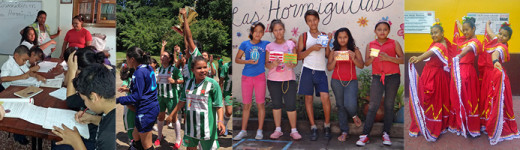
The project enables 70 working children and youths from unstable family backgrounds to attend school each year. The boys and girls receive support and guidance in the form of extra tuition, further training courses and a varied activity program. The integrated educational program helps them to overcome emotional burdens and strengthen their self-esteem. They are given a chance to be children and are encouraged to make school the focus of their daily lives.
Facts and Figures
Centro de Promoción Social de Niños, Niñas y Adolescentes Trabajadores
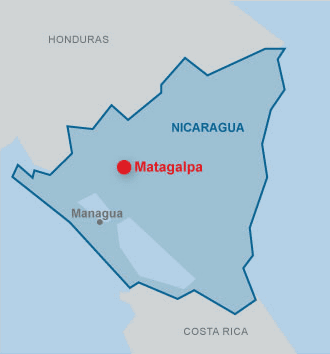
Matagalpa
Nicaragua
Phone: +(505) 2772 2181
1992
María Isabel Gutiérrez, Director
supported by a teacher, two tutors/caregivers, a social worker (part-time) and a dance teacher (part-time)and a secretary
- Annually, over 70 children und youths aged from 8 to 15, who work
- Their parents, representing 60 households, are also advised and given help
- Opportunities for schooling in a rented project centre
- Library with books, reference works, textbooks, games and handicraft materials
- Four older computers for computer lessons
- Assuring access to primary or secondary school
- Targeted remedial teaching in the project centre
- Psychological support und presentation of perspectives
- Holistic encouragement through a multi-faceted activities program
- Courses and information events involving parents and children
- Frequent home visits
CHF 39’500.– (2026)
EEF support since 2016
Continuous school attendance by the recipients as well as the opportunity for better life perspectives through school completion. Overall, it is hoped that a positive attitude towards schooling will be developed and an appreciation of the value of training strengthened
The Project
Background
In Nicaragua, the government, employers and families are legally obligated to prevent child labour. However, the current poor economic situation makes it extremely difficult for many families not to send their children to work and/or not to transfer household duties to them. By 2016, the number of people living below the national poverty line had fallen to 25 per cent. More recent data is unavailable, but international organisations suspect a further decline. However, this trend is considered fragile. On the one hand, many poor households in Nicaragua have only been able to maintain their purchasing power thanks to a sharp rise in remittances from the US and Costa Rica. Remittances rose because nearly 11 per cent of the population emigrated following the crackdown on the anti-government movement in 2018. On the other hand, climate change has increased risks in agriculture. Falling harvests have hit smallholders in rural areas particularly hard and have led to a rise in food insecurity. Many have therefore moved to the outskirts of larger cities to find work. In Matagalpa, too, many poorly qualified immigrants live in recently established districts on the outskirts of the city. During the coffee harvest, they work on the surrounding plantations, and in the other months eke out a living doing odd jobs in the city.
In the poorer areas, securing the family’s existence takes priority in most households. Thus children are kept at home to help instead of being sent to school. According to a survey by the International Labour Organisation (ILO), 48 per cent of 10- to 14-year-olds in Nicaragua were working in 2012, which equated to around 342,000 children. In 2015, UNICEF reported that over half a million children and young people aged between 3 and 17 were not attending school. The “School instead of child labour” project changes the lives of the boys and girls involved decisively. Over time, parents realise the value of schooling as their children complete primary education or pursue higher levels of education, ultimately securing better employment opportunities.
The project so far
The project’s predecessor organisation, Las Hormiguitas, looks back on a long history of experience. With the help of a Finnish organization, the mayor of Matagalpa in 1992 launched a food program for the children working at the Guanuca Market. However, this did not achieve a reduction in child labour. The project director, María Isabel Gutiérrez, therefore suggested placing the emphasis on education from 2000 onwards. She was able to attract new donors and persuaded the city government and the Movimiento Comunal Nicaragüense de Matagalpa to set up a project centre in the immediate vicinity of the market.
Since then the project team has continued to develop the concept further. Many youths completed their schooling and afterwards started – provided the funding was available – vocational training or university. Three former participants work in the project today. The small team has made an excellent name for itself in the city, and there is no other organization that concerns itself with the complex problems and hard social realities of child labour.
An annual total of 70 children and youths, aged 8 to 15 years, benefit from a range of project offerings. They come mainly from neighbourhoods surrounding the market, where they unload goods from vans, prepare vegetables, dash back and forth doing small jobs, drag packages from one place to the other, deliver meals to the market workers, sell produce or get rid of rubbish. Because many of them work for their own family’s stall, their pay – apart from a meal – is normally minimal.
Since 2018, the government has revoked the legal status of several thousand non-governmental organisations. At the end of 2023, the umbrella organisation of Las Hormiguitas, the Movimiento Comunal Nicaragüense de Matagalpa, was also closed by the state. To ensure the continuity of the programme, the project management team promptly devised alternative solutions. They rented smaller premises which, despite offering limited space for previous activities and beneficiaries, enabled the team to resume their essential work with 70 children and young people. Operating under the name “School instead of child labour”, the initiative has successfully restored effective support to working children and youth in Matagalpa.
Success and challenges
The project’s success is driven by a number of factors. Involving parents has resulted in the children being relieved of some of their daily labour and supported in their educational process. Access to free learning materials and scholarships enables them to attend school. Due to targeted extra tuition and psychological support, most beneficiaries complete school with good marks. In addition, children and youth are further encouraged with workshops and a multifaceted activities programme and, finally, supported during their entrance into the world of work. This combination of factors opens up significantly better prospects for their future.
“School instead of child labour” has for many years maintained close ties with schools, organizations and private persons. Contact with local schools allows for the rapid enrolment of children and teenagers in school. The good contact network also facilitates the organization of continuing education or of major events for the boys and girls as well as their parents.
The project team is always developing imaginative further ways to earn money for “School instead of child labour”. For instance, they run a photocopying service in the project centre and rent out tables and chairs for weddings. Unfortunately, however, the proceeds have not always covered all expenses before EEF support began. The project staff earned very low salaries. In the past, if an expected donation did not arrive, the staff simply didn’t receive part of their salary and had to reduce part of the project that was planned. But now, with the whole array of project offerings, the project goals can be effectively and lastingly achieved.
Goals
Each year the project allows 70 working children and youth to attend school. Supporting them with school materials, shoes, and daily extra-tuition guarantees that at least 85 percent of the pupils can be promoted to the next grade and ultimately complete their schooling.
The working children and youth live in vulnerable social conditions. They are poor, neglected and often victims of family violence. Thanks to psychological supervision and workshops, the beneficiaries overcome their emotional burdens, raise their self-esteem and begin to recognize life goals in the perspectives shown to them.
The rich and varied activities program helps the children and youths to become stronger both in body and in spirit, and transmits basic social values and norms. At the same time, it fosters their mental and physical development.
Close parental involvement is an essential component of the project. By means of a contract, parents promise to reduce their child’s workload, to support him/her in attending school, to participate in the workshops and generally to support “School instead of child labour” through active cooperation. Relations with parents are intensified by periodic visits to their homes. Furthermore, the project centre is always open for questions and advice.
Support by the EEF
After consultations and project visits by EEF representatives, the board of the equal education fund decided to support the work of “School instead of child labour” starting in 2016. It is important for the EEF to recognize the staff’s engagement by assuring them a reasonable salary. The effects of these payments are passed on directly to the children in the form of instruction, psychological supervision and the structured activities program. Further funding will be spent on school equipment, books and materials for the workshops.
Connections with Europe in the form of city partnerships have existed for a long time. Through a photocopying service, the rental of chairs and tables and contributions by the parents of the beneficiaries, the project also generates some of its own income. With its engagement in the project, the EEF intends to expand this self-generated income. A basic element of this engagement would be the professionalisation of reporting and bookkeeping. In addition to financial support, the EEF will therefore contribute its know-how in the areas of administration and planning.
Nicaragua
6,9 million inhabitants (estimate 2025)
129’494 km²
(three times the size of Switzerland)
CHF 8’100.– (2026, adjusted for purchasing power)
Prices in Matagalpa (as of October 2025)
- 1 litre of petrol:CHF 1.10
- 1 litre of milk:CHF 1.–
- 1 litre of Coca-Cola:CHF 1.15
- 1 kilo of bread:CHF 2.85
- 1 kilo of rice:CHF 1.20
- 1 cinema ticket:CHF 2.20
- 1 pack of cigarettes:CHF 2.60
- 1 bar of soap:CHF –.55
Sources:
OpenFactBook, ILO, Unicef, World Bank, US Department of Labor, information from María Isabel Gutiérrez, own formatting and calculations.
Video
Project presentation
Gallery
_gallery_teaser.jpg?lm=1781257992)
Nicaragua “School instead of child labour” Picture Gallery 2025
view album
_gallery_teaser.jpg?lm=1745437107)
Nicaragua “School instead of child labour” Picture Gallery 2024
view album
_gallery_teaser.jpg?lm=1723015190)
Nicaragua Las Hormiguitas Picture Gallery 2023
view album
_gallery_teaser.jpg?lm=1686902127)
Nicaragua Las Hormiguitas Picture Gallery 2022
view album
_gallery_teaser.jpg?lm=1650532506)
Nicaragua Las Hormiguitas Picture Gallery 2021
view album
_mobile-school_gallery_teaser.jpg?lm=1612801062)
Nicaragua Las Hormiguitas Picture Gallery 2020
view album
_gallery_teaser.jpg?lm=1584608696)
Nicaragua Las Hormiguitas Picture Gallery 2019
view album
_gallery_teaser.jpg?lm=1570691851)
Nicaragua Las Hormiguitas Picture Gallery 2018
view album
_gallery_teaser.jpg?lm=1570691589)
Nicaragua Las Hormiguitas Picture Gallery 2017
view album
_gallery_teaser.jpg?lm=1570691262)
Nicaragua Las Hormiguitas Picture Gallery 2016
view album
_gallery_teaser.jpg?lm=1570691049)
Nicaragua Las Hormiguitas Picture Gallery 2015
view album